

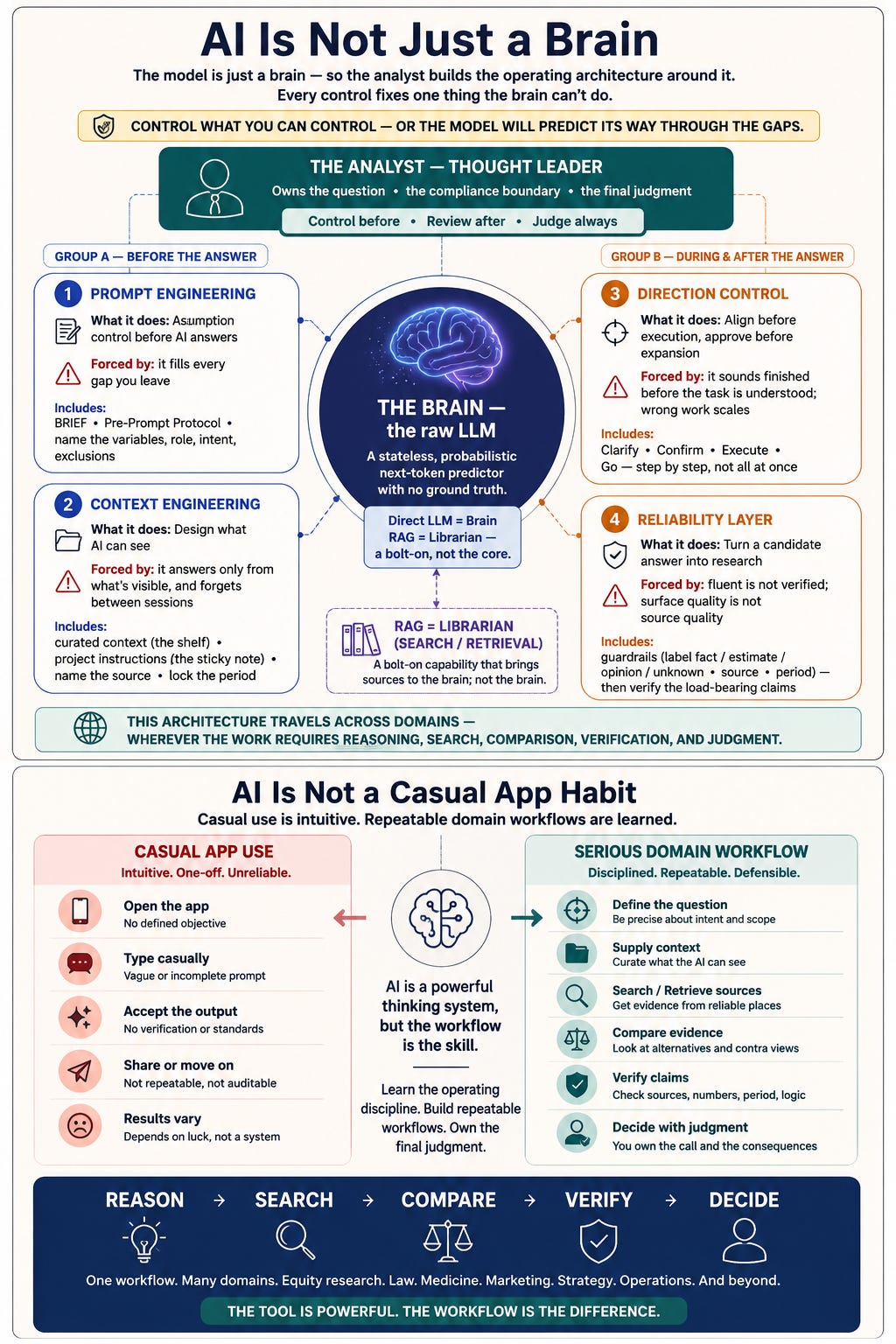
Tools Will Change. The Thinking Won’t.
Notes from my recent CFA workshop in Delhi on using AI as a controlled research system.
I’m sharing the slides from that session below. One thing I keep rediscovering every time I teach this material is the wisdom of a veteran investor who first encouraged me to teach: the person who teaches learns the most. Preparing and teaching this has forced me to clarify my own thinking on AI far more deeply than simply using the tools ever would have.
Everyone wants demos. Here’s the trade-off.
A common request from participants was for more live demos and examples. I completely understand it — examples are useful, demos are useful. But in a 4–5 hour session, there is a real trade-off, and it is unavoidable.
I had planned five modules. Even after deliberately avoiding detailed live demos, I could complete only about 3.5 of them. So the choice was stark: spend the limited time showing examples of specific tools, or spend it on the concepts that help people use any tool better.
I chose the second — and I’d make the same choice again.
Without concepts, examples are just imitation.
My belief is simple: tools and interfaces will keep changing, but the underlying thinking will remain useful. Without concepts, examples become imitation. With concepts, people can adapt across tools, domains, and workflows.
There are already plenty of YouTube videos, product tutorials, and blog posts showing tool-specific examples. What I wanted to do in this workshop was different — to explain how analysts and professionals should think about AI as a system: how to ask better questions, provide better context, verify output, control assumptions, and retain human judgment. That is the part the tutorials skip, and it’s the part that outlasts any particular tool.
Why I teach it this way.
I should be clear about my own intent, because it shapes the format. I do these sessions on a pro bono basis, and I’ve declined multiple paid assignments — my core work remains full-time investing. I’m not building an AI training business. I teach this as a small payback to the investment community, and I prefer to do it only through educational or professional institutions.
That constraint has a direct consequence. If the objective were detailed live demos, tool walkthroughs, case studies, and hands-on examples, the format naturally becomes a week-long or two-week course. That’s a different commitment, and not one I intend to take on. For a limited workshop, the most valuable thing I can hand over is the conceptual architecture — the scaffolding everything else hangs on.
AI learning isn’t one thing.
How much you need to learn depends entirely on what you want AI to do. It isn’t a single skill; it’s a ladder, and different rungs demand very different effort.
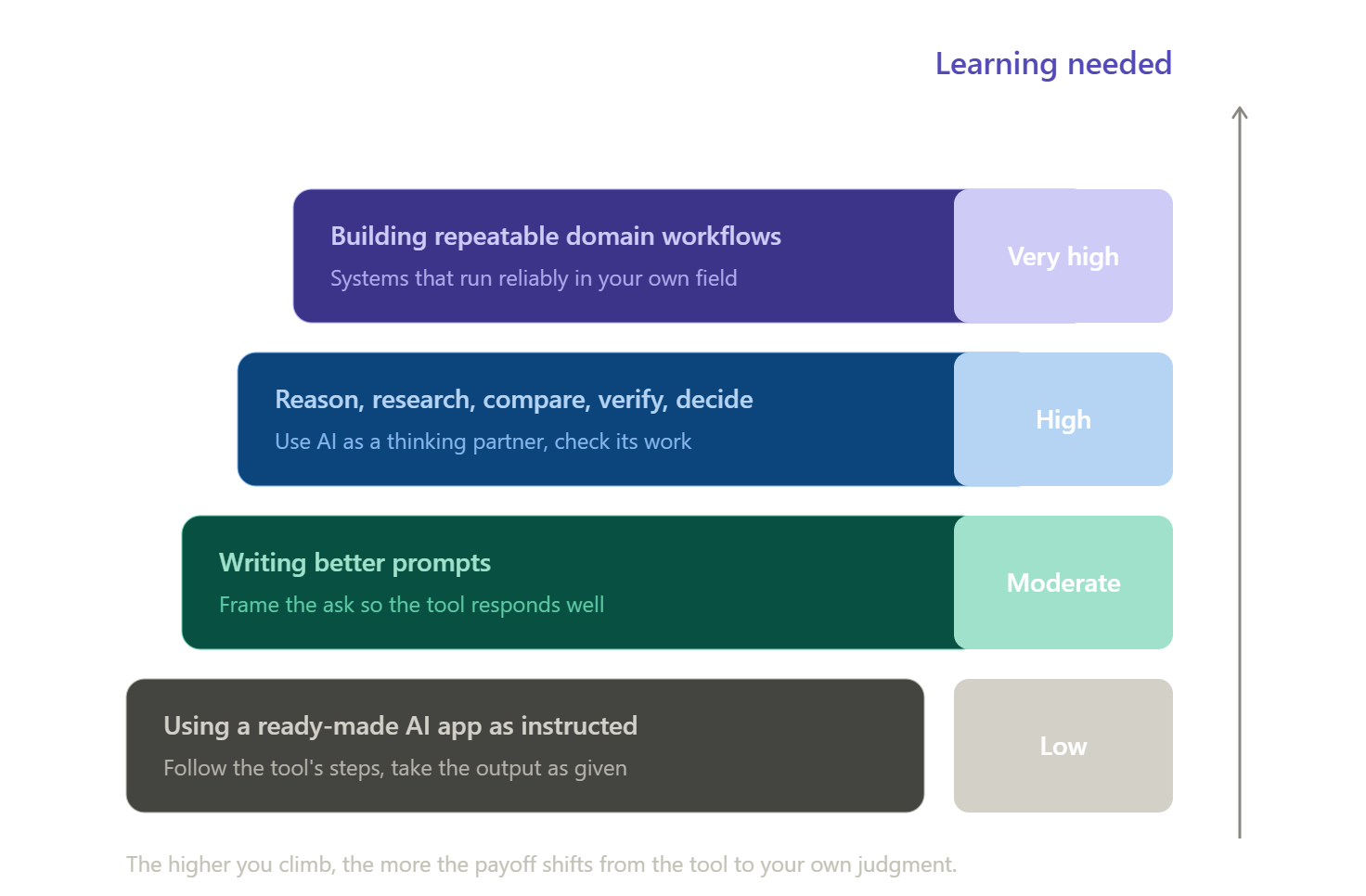
The workshop lives in that moderate-to-high band. But real mastery sits at the bottom row — very high — and that’s precisely the rung a 4-hour session cannot deliver, because it’s built on practice rather than explanation.
A starting architecture, not a finish line.
So these slides are not a substitute for practice. They are a starting architecture.
Anyone who wants to use AI seriously in their domain — whether investing, law, medicine, marketing, strategy, or any other field — will have to spend time applying, testing, and adapting these ideas to their own work.
That is where the real learning begins.
